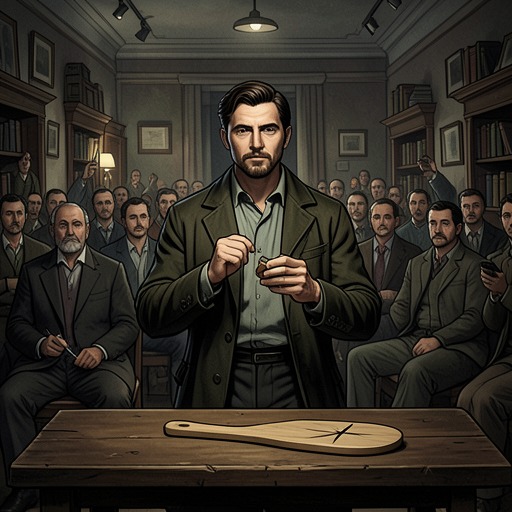
“Your time in hospital may well hurt them a lot more than it hurts you.”
This Is Going to Hurt“Your time in hospital may well hurt them a lot more than it hurts you.” is the culminating expression of Adam Kay’s appeal for patients and the public to reckon with the human cost of medical work. It does not deny what patients endure in hospital; it asks readers to see that clinicians, too, carry distress away from the bedside, sometimes without the support or space to recover.
The Claim and Its Context
The phrase appears near the end of Kay’s account, in a direct appeal to readers considering attacks on the National Health Service. He asks them not to accept an MP’s criticism unthinkingly, but to remember the toll borne by doctors, nurses, and midwives at work and at home. The sentence’s careful qualification—“may well”—makes it an invitation to reconsider whose suffering is visible, not a claim that every patient’s pain is lesser than a clinician’s.
The wording turns the familiar perspective of hospital care outward. Patients arrive needing treatment, and their fear and loss remain real; Kay’s point is that the people providing care are not untouched observers. Their work can expose them to other people’s worst days, while professional expectations encourage them to return to the ward and continue as if nothing has happened.
Encounters That Make the Cost Visible
Earlier episodes show the closeness that can make clinical work emotionally consequential. In 2006, Kay learns that a patient he had seen in A&E has cancer and only months to live. He had suspected cancer when he first saw her but had not said the word, having been taught that a patient may remember it as though it were repeated for half an hour. Now she weeps over the future she expects to miss: her son’s graduation, her daughter’s wedding, and meeting grandchildren. She also worries that her husband will not know how to manage the boiler. They laugh together, but Kay knows he cannot honestly promise that everything will be fine. Talking through practical concerns seems to help her, and he wonders whether he is the first person she has been able to open up to about them.
In 2008, the rota’s constant movement makes it unusual for Kay to see the same patient twice. On labour ward, however, he recognizes a doctor whose baby’s heart had stopped earlier in the week. She and her husband seem relieved to see a familiar face who already knows what has happened. Kay recognizes how little his training has prepared him to speak with a couple who have lost a child: he cannot tell whether hopeful words about a future pregnancy, an expression of sympathy, or a hug would help or hurt. He instead explains what will happen next, answers their questions as best he can, and returns roughly every hour. When the evening passes eight, he stays until the birth has happened. The scene gives the closing expression a quieter meaning: care includes remaining present when there is no phrase capable of undoing the loss.
A Crisis and Its Aftermath
The most devastating context for the expression comes in a later emergency caesarean. As a junior doctor begins the operation with Kay assisting, cutting into the womb releases a huge amount of blood. Kay takes over when the baby cannot be delivered around an obstruction and realizes that something serious has gone wrong and should have been detected during the pregnancy scans. The baby is born dead; attempts to save it fail. Meanwhile, the patient loses blood in escalating amounts. Kay holds her womb in both hands to try to stop the bleeding, but the loss reaches twelve litres before the most senior doctor has to remove her womb. The patient is transferred to Intensive Care, and Kay is told to expect the worst. Instead of completing his notes, he cries for an hour.
Kay had witnessed deaths before, but this was the first time he was the most senior person on the ward when disaster struck. Everyone had looked to him, and he felt that he had failed. Other doctors, he was told, would have acted in the same way with the same result; he had broken no rules and done nothing wrong. Still, he repeatedly wondered what might have been done differently and whether he could have prevented the tragedy. The gap between being told that he was not at fault and feeling responsible became central to the aftermath.
He returned to work the next day, but says he was a different doctor. Afraid that another terrible outcome might occur, he resolved to perform a caesarean if a baby’s heart rate dropped even slightly, knowing that some women would undergo operations they did not need. The decision shows how the event changed his response to risk: the immediate aim was to get everyone out of the room alive, while the lasting fear pushed him toward intervention. He came to understand why senior doctors feared taking risks, but recognized that carrying on was not the same as recovering. For the next six months, he did not laugh; his smiles were not real.
Silence, Departure, and the Final Appeal
The hospital did not make sure Kay had someone to talk to, although he believed he should have been able to seek help. He describes a code of silence that keeps support from the people who need it most. Work continued to demand his presence: staff were expected to come in the next day after terrible events, and the rota did not have room for a sick day. His observation that bad things happen too often to take a month off captures the routine pressure behind the apparently exceptional crisis. The expression therefore points beyond an individual’s private grief to a workplace in which distress can be treated as simply part of the job.
A few months later, Kay left medicine. At first he could not talk about why; later he simply did not talk about it, changing the subject and telling funny stories instead. Some of his closest friends would encounter the story only in the book. As a writer, he no longer misses the medical version of a bad day, though he misses colleagues, helping people, and the feeling of having made a difference on the drive home. The closing sentence is shaped by that double knowledge: clinical work can wound the people who do it, and it can also give them forms of purpose they continue to miss after leaving.
The final appeal asks readers to hold both realities in view. Kay points to the sadness doctors remember in exact detail, to voices that still shake when they recount it, and to the limits of what one memoir can represent: this is one doctor’s point of view, offered as a glimpse of the work. The sentence’s force lies in making that testimony public. It asks the audience to consider the clinicians’ lives beyond the hospital encounter and the suffering they may carry home, without suggesting that the patient’s own pain is unreal or unimportant.